ART EXPERIENCES FOR SENIOR LIVING COMMUNITIES // LOS ANGELES
Something interesting to make.
Artist-designed courses for senior living communities, built around generous materials, approachable techniques, and clear prompts with room for interpretation. Playing with scale runs throughout the curriculum as familiar objects are made larger than life.
No art experience required. All materials included.
ART COURSES
Multi-week courses in clay, collage, and papier-mâché, designed for senior living communities.
Each course develops skills through a sequence of projects, moving from simple techniques toward more complex ways of shaping, constructing, and composing. Everyone begins with the same materials and prompt, but makes something different — often working at an enlarged scale and with plenty of material to explore. Some classes end with sharing, looking at the work together, and titling each piece, while every course concludes with a final exhibition in the community.
01 // CLAY
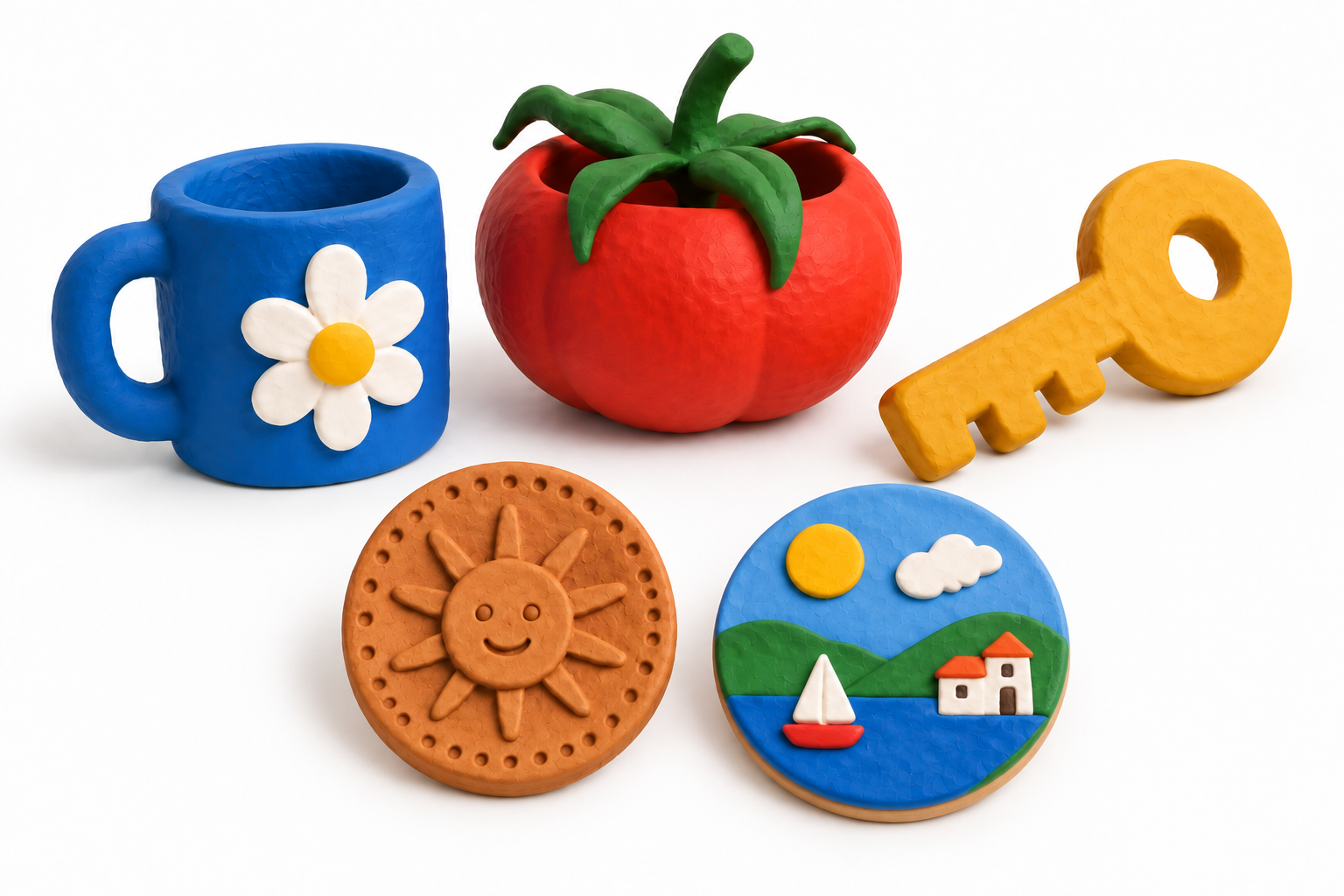
Shape, press, roll, and build with air-dry clay, transforming familiar objects into larger-than-life sculptures. Each project begins with something recognizable — a household object, a key, an animal — and changes it through scale.
These are two-session projects that begin with shaping and end with color. The first class focuses on learning clay techniques and building the sculpture. In the second, residents work from a simple palette of primary colors, learning to mix and choose colors as they paint their finished piece. We end by looking at the work together and inviting residents to share what they made, the choices they made, or anything they’d like others to notice.
Each work is then titled and saved for a final exhibition bringing together everything made throughout the course.
10 CLASSES // 2 classes per project + exhibition
01 // On The Table
Observational form. Introduction to hand-building
Choose an everyday object you might find on a table and remake it at a much larger scale. A pencil, cup, piece of fruit, pair of glasses — anything ordinary becomes a little less ordinary when its size changes.
02 // The Vessel
Hollow form. Introduction to vessel-building
Make an oversized container for one very specific thing. Decide what it holds, then build a vessel around it — whether it’s something practical, precious, strange, or imagined.
03 // In My Pocket
Observational form. Developing hand-building
Choose something small you might carry in your pocket or bag and make it much bigger than it should be. A key, button, comb, lipstick, pocket watch, piece of jewelry, lucky charm, or something else — then see how the object changes when its scale does.
04 // The Coin
Slab construction. Introduction to relief
Invent a giant coin and decide what deserves to be pictured on it. A person, animal, place, object, or symbol — anything you think belongs on a coin of your own.
05 // The Souvenir
Choose a favorite place and design an oversized souvenir magnet for it. A city, neighborhood, vacation spot, or somewhere you’ve always loved — create something that captures what makes that place memorable.
Slab construction. Developing relief
FINAL // Exhibition
At the end of the course, the finished sculptures are brought together for a small exhibition in the community. Residents choose titles for their work and help prepare simple labels, creating a chance to see the full collection side by side and share what they made with neighbors, friends, and family.
02 // COLLAGE
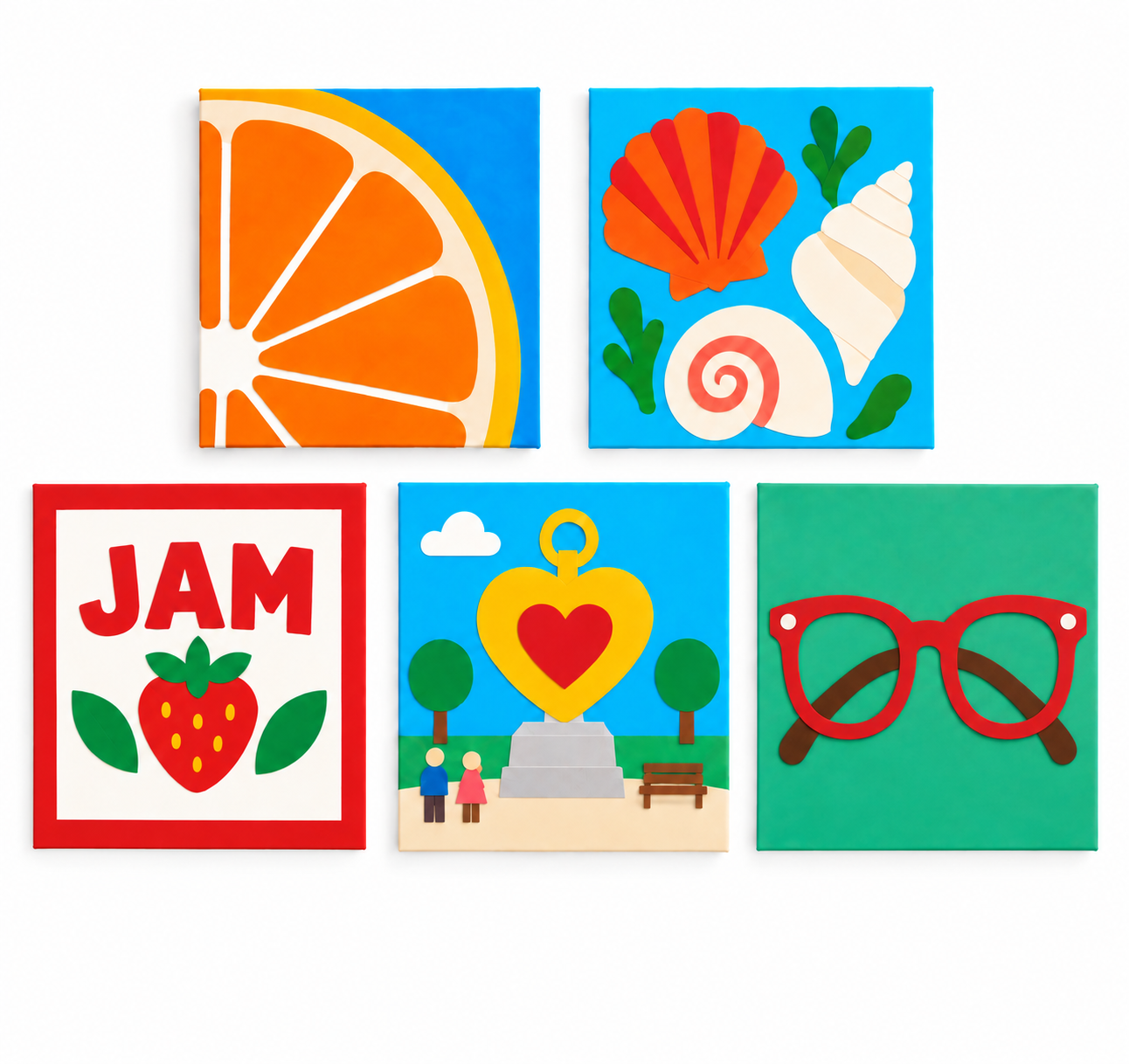
Cut, tear, layer, and arrange colored paper on stretched canvas, transforming familiar objects into oversized compositions. Each project begins with something recognizable — a small everyday object, a collection, a label, a personal possession — and changes it through scale, color, and arrangement. We work entirely with colored paper, with no magazines or printed images.
These are single-session projects that begin with shape and build toward composition. Each class starts with a short demonstration of cut-paper techniques before residents begin arranging large shapes, experimenting with color, and building their image piece by piece. The emphasis is on simple forms and bold decisions rather than intricate cutting or drawing. We end by looking at the work together and inviting residents to share what they created, the choices they made, or anything they’d like others to notice.
Each work is then titled and saved for a final exhibition bringing together everything made throughout the course.
5 CLASSES // 1 class per project + exhibition
01 // The Close-Up
Shape + scale. Introduction to cut-paper collage
Choose a small, familiar object and bring it into close view, enlarging it until it fills the canvas. A button, orange slice, wrapped sweet, or seashell — decide which shapes and details are enough to make it recognizable.
02 // The Collection
Repetition + variation. Developing composition
Choose something small you’d like to collect and create three enlarged versions of it. Shells, sweets, buttons, little bottles, or something of your own —change their colors, patterns, or proportions to make each one different.
03 // The Label
Image + lettering. Combining text and image
Design an oversized label for something that comes in a jar, box, bottle, tin, or other type of packaging. Jam, biscuits, perfume, or something you invent — use bold paper shapes and pre-cut letters to give it a name and show what’s inside.
04 // The Monument
Relative scale + setting. Developing spatial composition
Choose something small that feels special, useful, or worth remembering and turn it into a monument. Decide where it belongs — a city, garden, park, or somewhere imagined — then surround it with smaller elements that make its oversized scale clear.
05 // A Portrait Without A Face
Symbolic image. Developing visual storytelling
Choose a small object that tells us something about you or someone you know and enlarge it to fill the canvas. A favorite cup, chess piece, cooking utensil, or something personal — let the object stand in for the person without showing their face.
FINAL // Exhibition
At the end of the course, the finished sculptures are brought together for a small exhibition in the community. Residents choose titles for their work and help prepare simple labels, creating a chance to see the full collection side by side and share what they made with neighbors, friends, and family.
03// PAPIER-MÂCHÉ
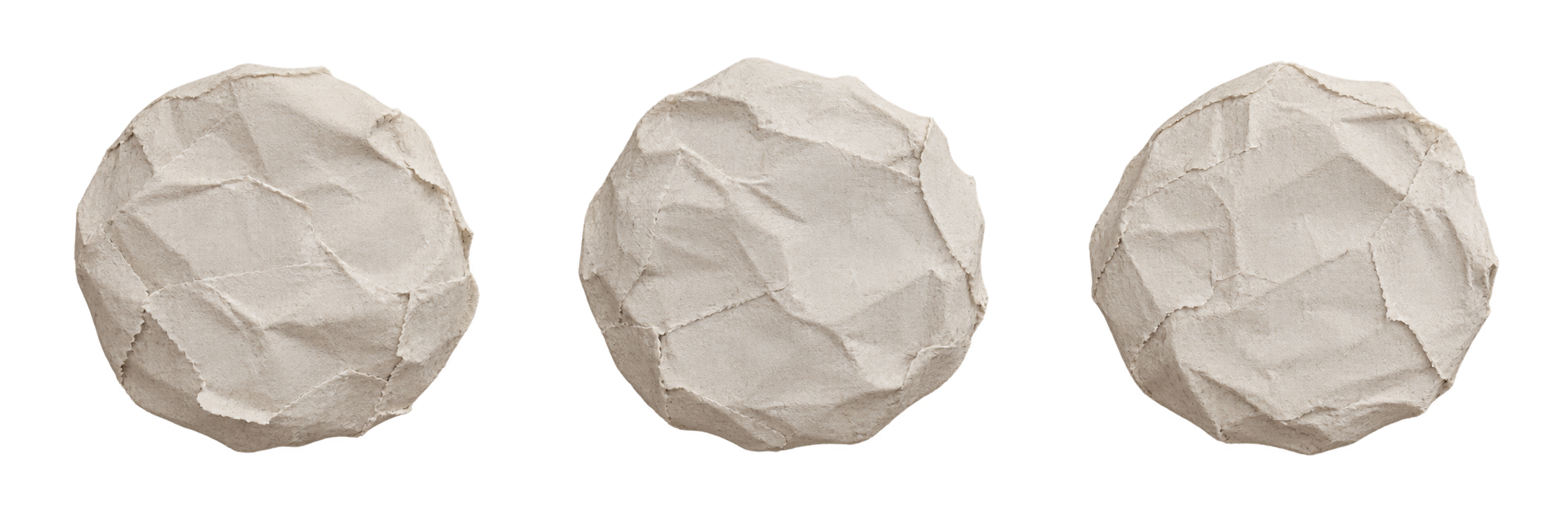
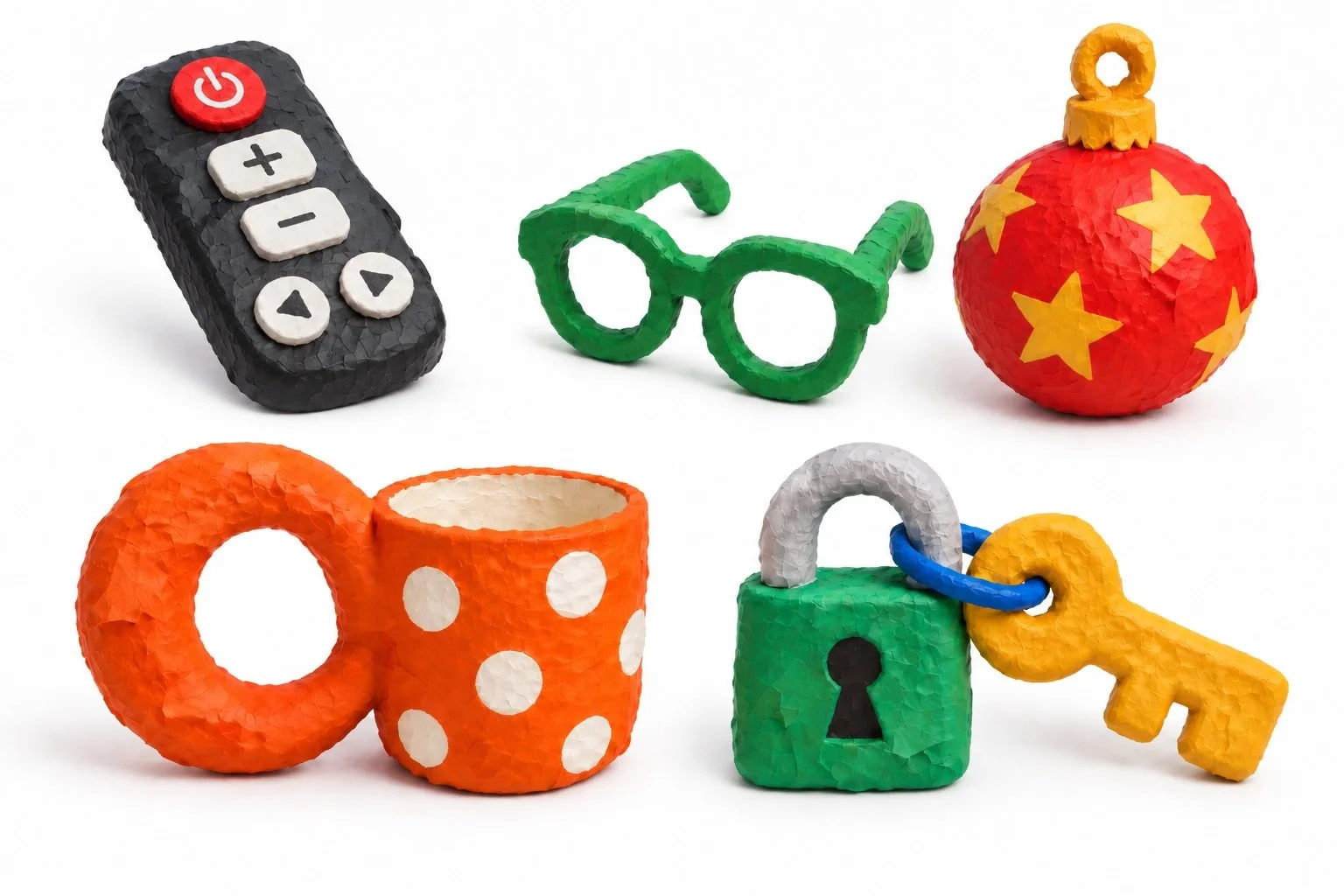
Crumple, shape, layer, and build with papier-mâché, transforming familiar objects into lightweight, larger-than-life sculptures. Each project begins with something recognizable — an everyday tool, an accessory, a special-occasion object, or a pair of things that belong together — and changes it through scale, proportion, and exaggeration.
These are two-session projects that begin with building and end with color. In the first class, residents learn simple papier-mâché techniques and construct the main form of their sculpture. Once the work has dried, we return for a second class focused on painting, working from a limited palette of primary colors to mix new colors, build contrast, and finish the piece. We end by looking at the work together and inviting residents to share what they made, the choices they made, or anything they’d like others to notice.
Each work is then titled and saved for a final exhibition bringing together everything made throughout the course.
10 CLASSES // 2 classes per project + exhibition
01 // The Everyday Hero
Shape + scale. Introduction to papier-mâché
Choose a small, ordinary object that makes everyday life easier and remake it much larger than life. A whisk, hairbrush, remote, key, or something else — give an overlooked object more attention than it usually gets.
02 // The Accessory
Contour + detail. Developing simple forms
Choose a small object you wear and remake it much larger than life. A watch, cufflink, tie clip, ring, pair of glasses, lapel pin, or something else — change its scale until something designed to be worn becomes a sculpture.
03 // Special Occasion
Layering + smoothing. Refining the surface
Choose something that only comes out at certain moments and remake it at an exaggerated scale. A serving dish, hat, vase, cake server, ornament, or something else — take something usually saved for special moments and make it the main event.
04 // One Part Too Big
Proportion + exaggeration. Altering form
Choose a familiar object and exaggerate one part of it until it changes the whole thing. A cup might have an enormous handle, a comb might have giant teeth, or a shoe might have an impossible heel — decide which part gets to take over.
05 // The Pair
Joining + composition. Combining multiple forms
Choose two familiar things that naturally belong together and remake them as one oversized sculpture. A cup and saucer, lock and key, salt and pepper, needle and thread, or something else — decide how the two forms meet, relate, or depend on one another.
FINAL // Exhibition
At the end of the course, the finished sculptures are brought together for a small exhibition in the community. Residents choose titles for their work and help prepare simple labels, creating a chance to see the full collection side by side and share what they made with neighbors, friends, and family.
Why this works
A real art course, made approachable.
Each course combines clear instruction, generous materials, and room for individual decisions. Residents learn techniques, develop skills over time, and make work that is entirely their own.
ARTIST-LED
We teach the materials and techniques, then give residents a clear prompt and room to make their own decisions. Everyone starts together and ends somewhere different.
NO ART EXPERIENCE NEEDED
We introduce each technique step by step and design every prompt to be easy to understand, with plenty of room for individual interpretation.
WE COME TO YOU
We bring everything needed for the course — from generous amounts of material and setup to instruction and cleanup.
SKILLS BUILD OVER TIME
We structure each course as a progression, beginning with simple techniques and building toward more developed ways of shaping, constructing, and composing.
MAKING ART CAN BUILD COMMUNITY.
A visual arts program in residential care was found to foster a sense of community and greater self-worth as artists. A public exhibition also gave meaning and purpose to residents’ participation.
— Rodrigues et al., Canadian Journal on Aging, 2019
WHERE WHITEWATERRAFTING CAME FROM
Whitewaterrafting was founded by Eugenia Moreeva, a Los Angeles–based artist, educator, and CalArts graduate. She began teaching four years ago with deep-reading classes for high school students, then co-founded a literature program with two friends at Meinkurs, an online school in Russia. She also organized experimental art gatherings in Moscow, Russia, bringing together poetry, visual environments, sound, food, and guided sensory experiences. After graduating from CalArts, she moved into visual art education, teaching children and adults through several arts organizations and education companies across Los Angeles.
Her artwork explores how people navigate the structures, systems, and situations they find themselves in. Whitewaterrafting brings that interest together with her teaching practice: showing people how to work with a material while leaving the outcome open. Everyone begins with the same materials, conditions, and somewhere interesting to start, then takes the work in their own direction.
That mix of uncertainty, momentum, and fun is where the name comes from. Making something you’ve never made before means making decisions as you go, without knowing exactly what the finished result will be. Whitewaterrafting provides the structure, materials, and guidance that make the unknown feel exciting rather than intimidating.
Today, Whitewaterrafting brings together professional artists to lead these experiences in corporate offices, senior living communities, retreats, private events, and other places people come together to make something new.
TRY IT FIRST
Not ready for a full course? Communities can begin with a standalone experience before committing to a longer program.
ONE CLASS // FROM $850
Choose a single-session collage project, with all materials, instruction, sharing, artwork titling, and a mini exhibition of the finished work included.
TWO CLASSES // FROM $1,500
Try one complete clay or papier-mâché project — from building the form to painting, sharing, titling, and a mini exhibition of the finished work.
FULL COURSES FROM $3,500
5-class course starts at $3,500 // 10-class courses start at $6,500
All materials and final exhibition included.
A FEW PRACTICAL THINGS
-
All Whitewaterrafting workshops are led by professional working artists with a Bachelor of Fine Arts college degree or higher.
-
Pretty much everything. We bring the materials, tools, table protection, workshop setup, examples for demonstrating techniques, artist facilitation, and take care of cleanup afterward.
-
Most classes are designed for up to 15 residents with one teaching artist.
Larger groups can be accommodated with additional instructors so everyone has enough space, materials, and individual support.
-
Classes take place in your community in Los Angeles — in an activity room, art room, dining space, or another accessible area with tables. We ask for a comfortable seated workspace with enough room for residents and materials.
We typically just need tables, chairs, and access to the space before and after the workshop. We’ll confirm the exact setup with you ahead of time.
-
All classes run 90 minutes. Setup and cleanup happen separately, so the full class time is spent making.
Clay and papier-mâché projects are completed across two sessions so the work has time to dry before painting.
-
Because the goal isn’t to reproduce an example. We teach residents how to work with the materials, then give everyone the same clear prompt and starting conditions. The structure is shared; the finished work is individual.
-
No art experience is required. We introduce techniques step by step and design prompts to be immediately understandable, with room for residents to work at their own pace and make their own choices.
-
Yes. Our projects are designed to be completed seated at a table, and we can adjust tools, materials, pacing, and the level of hands-on support as needed.
Working at an enlarged scale is part of the artistic concept, but it also makes many projects easier to see, hold, cut, shape, and assemble. We can also provide pre-cut shapes, easier-grip tools, and other simple adaptations so residents can participate comfortably.
-
Residents keep their work. Throughout the course, finished pieces are titled and saved for a final exhibition in the community. Standalone trial classes can also conclude with a small display of the finished work.
-
We recommend booking 3–4 weeks in advance for a single class and 4–6 weeks ahead for a multi-week course. Earlier booking gives us the best chance of reserving your preferred day, time, and teaching artist. Shorter-notice bookings may be possible depending on availability.
-
A 50% deposit secures the starting date of the course/one-time trial class date, with the remaining balance due 7 days before the first class. We’ll send you a secure online invoice for payment.
Cancellations made more than 14 days in advance are refunded, less a $200 booking fee. Cancellations made within 14 days forfeit the deposit. Cancellations made within 7 days are nonrefundable.
Workshops may be rescheduled once with 14+ days notice, subject to availability.
-
Yes. We can provide standard vendor documentation, including a W-9 and proof of general liability insurance. Your community can be named as an additional insured when required, and we’re happy to review and sign reasonable NDAs.
We can work with your community’s onboarding requirements when needed.
Let’s Make Together
Tell us a little about your community, how many residents you’re planning for, and what kind of course you’re interested in. We’ll get back to you within 48 hours.
Rather talk it through?
BOOK A 15-MINUTE INTRO CALL